
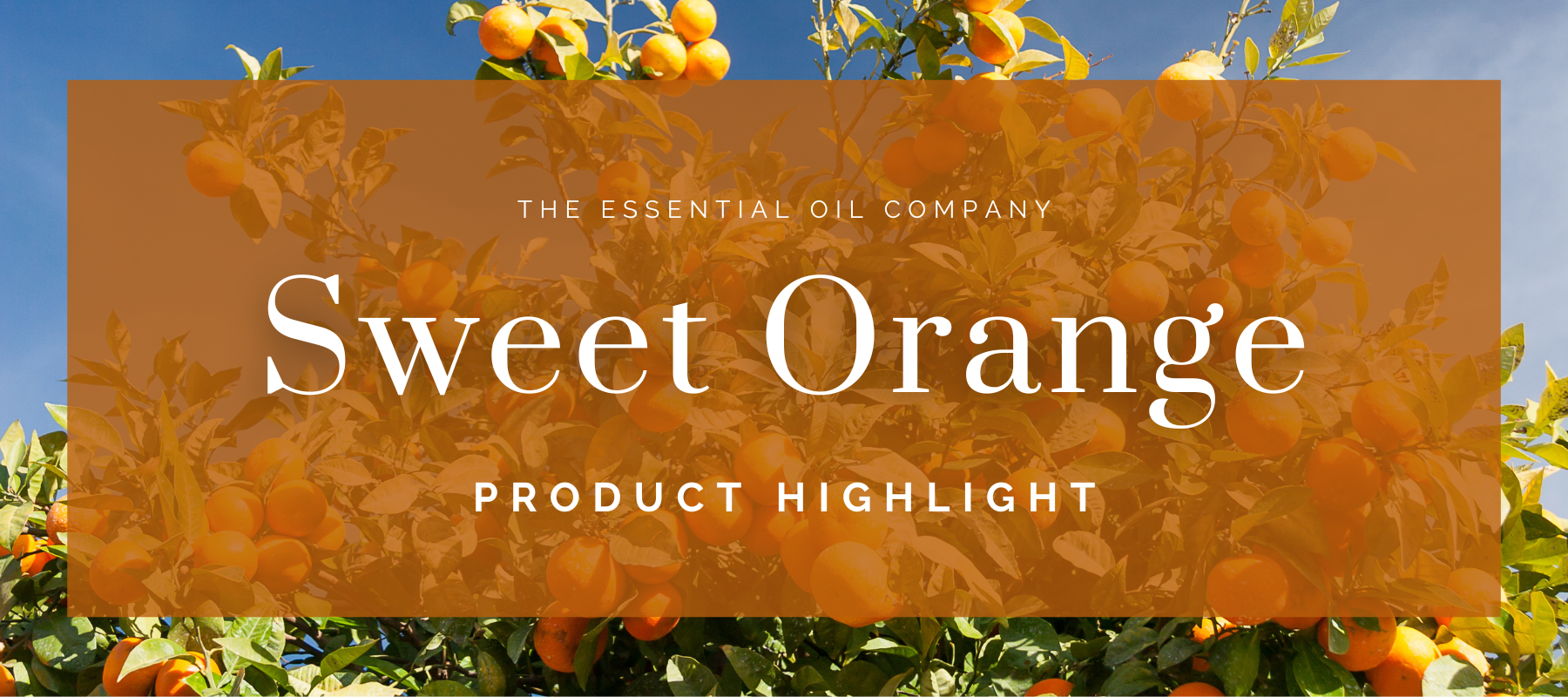
Sweet Orange essential oil is cold pressed from the rind of Citrus sinensis, as a byproduct of the juice industry. The oil is thin, yellow to deep orange, with a sweet, fresh citrus aroma.
Plant details
Sweet Orange (Citrus sinensis, also called Citrus aurantium dulcis) is a fruiting tree in the Rutaceae family of citrus plants. It was originally thought to be a form of the Bitter Orange (Citrus aurantium amara) and was called Citrus aurantium var. sinensis. Oranges are thought to have first come from trees native to China, but the exact origin of the Sweet Orange is unknown because it does not grow anywhere in the wild. Botanists believe it is a natural hybrid of the pomelo (Citrus maxima) and the mandarin (Citrus reticulata) that originated somewhere in southwest China.
The trees are evergreen and typically grow ten to twenty-five feet tall, reaching up to fifty feet at a mature age. They have grayish-brown bark and slender branches that grow evenly around the tree in the shape of a hemisphere. The leaves are oval, dark green and glossy, three to four inches long. The small white flowers grow singly or in small clusters and are very fragrant.
The fruit is round with a thick, almost leathery rind that turns from green to orange as it ripens. In warmer climates the rind can keep patches of green or stay entirely green. The rind is dotted with the glands that contain the essential oil. Beneath it is a layer of spongy white tissue called the pith, and inside are a dozen wedge-shaped segments of juice-filled pulp.
History
The Sweet Orange was mentioned in Chinese literature as early as 314 B.C. In China, oranges are believed to symbolize good fortune. Sweet Oranges are thought to have been introduced to the Iberian Peninsula during the tenth century, an idea supported by irrigation techniques specifically adapted to orange orchards. They did not spread into the Mediterranean until the beginning of the fifteenth century, when Portuguese and Italian merchants brought the trees into the area. The fruit was at first a luxury for the wealthy. By the middle of the seventeenth century oranges were well known throughout Europe, and many aristocrats kept private orangeries. Louis XIV built a particularly grand Orangerie at the Palace of Versailles, which allowed oranges to be grown year-round for the court.
Spanish travelers brought the Sweet Orange to the Americas. In 1493, on his second voyage, Christopher Columbus brought orange seeds and may have planted them in Hispaniola. During the Age of Discovery, sailors planted citrus trees along their trade routes. Oranges spread to South America and Mexico in the sixteenth century and reached Florida in 1565, when Pedro Menéndez de Avilés founded St. Augustine. Missionaries and explorers carried the trees across North America over the next two centuries. Oranges reached Hawaii in 1792, when the botanist Archibald Menzies raised seedlings on board ship from seeds collected in South Africa and gave them to several Hawaiian chiefs. The fruit was grown widely there until Mediterranean fruit flies stopped its cultivation in the early twentieth century.
Extraction and aroma
Unlike many other fruits, the Sweet Orange does not continue to ripen once picked, so it must be harvested at the right time for ripeness and oil yield. Some oranges are still picked by hand, but many grown for essential oil are harvested mechanically with limb-shaking machinery or air jets.
Like other citrus oils, Sweet Orange is cold pressed from the rind. It is a byproduct of juice manufacturing, and there are two types of extractor. One scrapes the outer layer of the peel, water is added, and the essential oil is separated in a centrifuge. The fruit then goes to a juice press. The other presses halved oranges, giving a mixture of juice and essential oil that is then separated in a centrifuge.
The resulting oil is thin, varies from yellow to deep orange, and has a sweet, fresh citrus aroma. Like many citrus oils it can be photosensitizing on skin.
How makers use sweet orange
Sweet Orange is used to scent hand soap, room sprays and diffuser blends. It is a strong deodorizer that leaves a clean, fresh scent. In the recipes below it is blended with frankincense, peppermint and black pepper, with lemon and eucalyptus, with lavender and bergamot, and with cedarwood and lavender.
Recipes

Rise and Shine Diffuser Blend
Ingredients
- 3 parts Sweet Orange Essential Oil
- 3 parts Frankincense Essential Oil
- 2 parts Peppermint Essential Oil
- 2 parts Black Pepper Essential Oil
Instructions
Add water to your diffuser up to the fill line, then add the blend. The recipe was written for a 200 mL ultrasonic diffuser, using about 0.5 mL of oil in total. Adjust the amount to the size and directions of your diffuser.

Fresh and Clean Hand Soap
Ingredients
- 16-ounce Foaming Soap Dispenser
- ¼ cup Unscented Liquid Castile Soap
- ½ cup Distilled Water
- 15 mL Sweet Almond Oil
- 15 mL Vegetable Glycerine
- 0.5 mL Sweet Orange Essential Oil
- 0.4 mL Lemon Essential Oil
- 0.25 mL Eucalyptus Essential Oil
Instructions
Add all ingredients to the foaming soap dispenser, replace the top and shake well to combine.
Orange, Lavender and Bergamot Roll-On
Ingredients
- 10 mL Amber Glass Roll-On Bottle
- 10 mL Fractionated Coconut Oil
- 0.25 mL Sweet Orange Essential Oil
- 0.15 mL Lavender Essential Oil
- 0.1 mL Bergamot Essential Oil
Instructions
Add the essential oils to the bottle. Fill the rest of the bottle to the top with fractionated coconut oil. Replace the rollerball and cap, shake gently and roll across your skin.

Orange and Cedarwood Deodorizing Room Spray
Ingredients
- 4 oz Amber Glass Bottle with spray top
- 2 oz High Percentage Alcohol
- 2 oz Witch Hazel Extract
- 1 mL Sweet Orange Essential Oil
- 1 mL Cedarwood Essential Oil
- 0.5 mL Lavender Essential Oil
Instructions
Add 2 ounces of high percentage alcohol to the bottle. Add the essential oils and fill the remainder of the bottle with witch hazel, leaving a little space at the top. Shake well before each use.
Find the oil used in these recipes here: Sweet Orange essential oil, also available as Certified Organic Sweet Orange.