
Skip to content

Essential Oil · Minty & Cooling

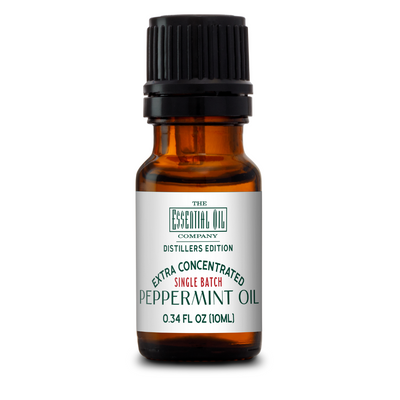
Peppermint Oil

Mentha piperita

Peppermint (Mentha piperita) is a cooling, menthol-rich essential oil steam distilled from the leaf. Defined by menthol, menthone, and the marker constituent menthofuran, true peppermint is distinct from cheaper corn mint - and American-grown peppermint has become its premium expression.

mintycoolingfreshsweet-herbaceous
Peppermint Oil
Plant part
Leaf
Extraction
Steam Distillation
Origins
United States, India, Italy
Chemical class
Monoterpenol, Ketone
CAS
8006-90-4
FEMA
2848
INCI
Mentha Piperita Oil

Watch

Why Peppermint Rules the Mint World: History, Menthol & Modern Farming
Origin story

Peppermint is not native to North America - it arrived with settlers and was first grown in small oil volumes in New York. The plant established here was Black Mitcham peppermint, cultivated primarily to flavor medicines, chewing gum, and confections.

Mint became part of daily life largely through toothpaste and chewing gum, two products that emerged around the turn of the century. Peppermint's cooling nature - driven by menthol - became strongly associated with cleanliness, which carried it into oral care, confections, chocolate, dental products, and aromatherapy.

Extraction & distillation

Peppermint oil is steam distilled from the leaf. The cultivation and harvesting of mint oils has evolved over the last two hundred years - and very quickly over the last thirty - as production has become more mechanized and efficient.

Historic high-quality US mint regions include Rochester, Indiana; Hermiston, Oregon; and the Yakima and Kennewick areas of Washington. In the 1990s the United States produced roughly 7-8 million pounds of mint oil a year from 500-600 farmers. Today North American output is closer to 3-3.5 million pounds from only 40-60 farmers, as flat prices and rising costs for land, water, and inputs forced growers to consolidate and mechanize. Meanwhile, production shifted heavily to India, whose main product is corn mint oil and de-mentholized oil (DMO), a by-product of menthol extraction.

Chemistry

Quality peppermint - whether grown in the United States, India, China, or Italy - is judged by a few key constituents:

  • Menthol - the primary component and the source of peppermint's cooling effect, typically around 40% (up to roughly 44%) in true peppermint
  • Menthone - another defining component of the flavor and aroma
  • Menthofuran - the marker that distinguishes true peppermint from corn mint: present in Mentha piperita (from about 0.2% up to 14-15% in Italian oils) but absent from corn mint oil

By contrast, corn mint (Mentha arvensis) produces up to about 80% free menthol - which is why it is the world's menthol source - but its flavor is more medicinal and heavier, and it is low on peppermint's other key components. In the US, origins are further differentiated by isopulegol and trans-sabinene hydrate percentages.

How peppermint is used

  • Oral care - toothpaste and mouthwash
  • Chewing gum, confections, and chocolate
  • Digestive and gut medicines
  • Aromatherapy for an uplifting, energizing effect
  • Traditional cooling rubs and pain-relief creams

Why we use it

Peppermint and spearmint have been central to our family and to this business for decades - we come from Elkhart, Indiana, in the heart of the historic US mint belt. We favor true Mentha piperita, identified by its menthofuran content, over the corn mint (Mentha arvensis) and de-mentholized by-product oils that dominate much of the global market.

Corn mint DMO is consistent, blendable, and inexpensive - and is actually the preferred mint flavor in parts of Europe - but genuine US peppermint oil has become a specialty item: a premium origin worth seeking out.

Safety notes

Peppermint is high in menthol and is a potent sensory active. Dilute appropriately for topical use, and keep menthol-rich oils away from the faces of infants and young children.