
Skip to content

Essential Oil · Herbal & Green

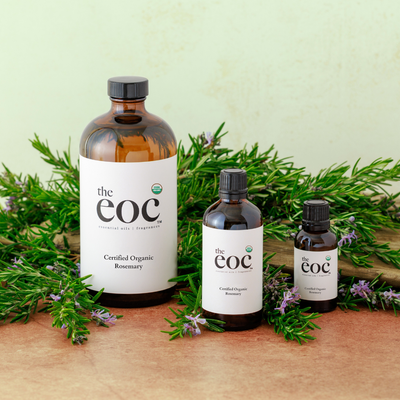
Rosemary Oil

Salvia rosmarinus (syn. Rosmarinus officinalis)

Rosemary oil is a steam-distilled essential oil from the Mediterranean herb of remembrance, produced mainly in Morocco and Tunisia and prized for its fresh, camphoraceous-herbaceous character.

herbaceouscamphoraceousfreshearthyeucalyptus-likeleafygreen
Rosemary Oil
Plant part
Leaf
Extraction
Steam Distillation
Origins
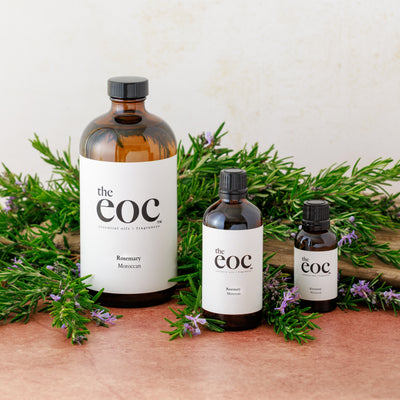
Morocco, Tunisia, Spain, France
Chemical class
Oxide, Monoterpene, Ketone
CAS
8000-25-7
FEMA
2992
INCI
Rosmarinus Officinalis Leaf Oil

Watch

Rosemary for Remembrance — 5,000 Years of History in 5 Minutes

Origin story

Rosemary - Latin ros marinus, "dew of the sea" - has grown on the rocky, salt-sprayed cliffs of the Mediterranean for thousands of years, thriving where almost nothing else survives. Dried sprigs have been found in Egyptian tombs dating to roughly 3000 BCE, placed with the dead as part of burial rituals.

Greek students braided it into garlands and wore it while studying, convinced it sharpened the memory - the origin of "rosemary for remembrance." The Romans layered on two more meanings, love and death: brides carried it at weddings while mourners brought it to funerals. The physician Dioscorides catalogued it in De Materia Medica, a text that remained Europe's standard medical reference for some 1,400 years.

By the Middle Ages rosemary was a household staple, burned in homes and sick rooms against plague. Around 1370 a rosemary-and-alcohol distillate called Hungary Water - attributed to Queen Elizabeth of Hungary - became one of Europe's first alcohol-based perfumes, the moment medicine and perfume began to blur. Shakespeare made the plant's symbolism permanent through Ophelia: "There's rosemary, that's for remembrance." And long before refrigeration, rosemary was one of the Mediterranean's most trusted meat preservatives - the practical reason it became embedded in the salt-cured and roasted meat traditions whose flavors we still know today.

Extraction & distillation

Rosemary is both cultivated and wild-harvested, primarily in the arid climates of Morocco and Tunisia, with additional production in Spain and France. The essential oil is steam distilled from the herb.

Separately, a non-volatile fraction of the plant is extracted and refined into rosemary extract - the natural antioxidant used across the food industry - which contains no essential oil at all.

Chemistry

Rosemary oil is dominated by two constituents - 1,8-cineole (eucalyptol) and camphor - alongside borneol, verbenone, and alpha- and beta-pinene. Three chemotypes are traded:

  • ct. cineole - the commercial standard, mainly Morocco and Tunisia, with camphor typically around 15%
  • ct. camphor - mainly Spain, with camphor reaching roughly 38-39%
  • ct. verbenone - lower volume and more expensive

The cineole type dominates the market because it is fresher and less medicinal than camphor-heavy oils. As isolates, cineole and camphor are now more economically sourced from other plants - cineole from eucalyptus, camphor from the camphor tree - a window into how the industry standardizes natural chemistry.

Cineole-chemotype rosemary - the commercial standard - typically runs around 40-47% 1,8-cineole, 11-17% alpha-pinene, and 9-15% camphor, with camphene, beta-pinene, caryophyllene, and borneol rounding out the profile.

How rosemary is used

  • Mediterranean cooking - Tuscan meat dishes, focaccia, porchetta, bouquet garni, herbes de Provence
  • Fragrance - top notes in fougere-style perfumes, soaps, and rosemary-mint personal care
  • Hair and scalp care formulation
  • Food preservation - rosemary extract (from the plant's non-volatile fraction, rich in carnosic acid, carnosol, and rosmarinic acid) widely replaces synthetic antioxidants like BHT and BHA in packaged foods
  • Natural animal care - flea and tick preparations

Aromatically, rosemary has been associated with memory and alertness since antiquity - an association modern researchers continue to explore.

Why we use it

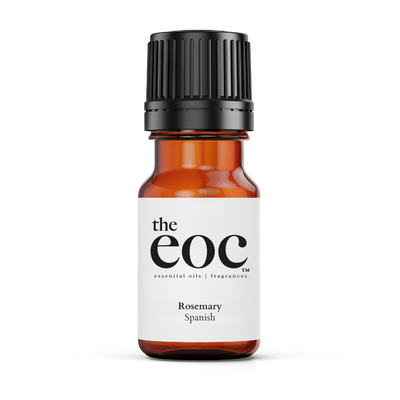
Know what you're buying. Pure rosemary oil ct. cineole is earthy - you can smell the soil in it - while the ubiquitous "Rosemary Oil Spanish" of commerce is usually a standardized technical material: a natural (or natural-and-synthetic) compound built from aromatic isolates, sometimes containing rosemary oil and sometimes not.

The technical grade smells cleaner and fresher, costs far less, and is the right tool for soap, shampoo, and functional fragrance work - but it is not the same material as a pure oil, and the price difference tells you which one you're holding.

Frequently asked questions

What are the chemotypes of rosemary oil?

Three are traded commercially: ct. cineole (the standard, dominated by 1,8-cineole/eucalyptol), ct. camphor (mainly Spanish, reaching roughly 38-39% camphor), and the rarer, more expensive ct. verbenone.

Where is rosemary oil produced?

Most pure rosemary oil, organic and conventional, comes from Morocco and Tunisia, with smaller production in Spain and France. The plant itself grows almost anywhere.

What is Rosemary Oil Spanish?

Usually not a pure oil from Spain. It's a standardized, technical-grade material compounded from aromatic isolates - cleaner-smelling and far less expensive than pure rosemary oil, and widely used in soaps, shampoos, and personal care.

Why is rosemary extract listed on food packaging?

A refined extract from rosemary's non-volatile fraction is a powerful natural antioxidant - rich in carnosic acid, carnosol, and rosmarinic acid - used to replace synthetic preservatives such as BHT and BHA in packaged foods.
Safety notes

Rosemary oil contains camphor and 1,8-cineole; dilute appropriately for topical use and keep away from the faces of infants and young children. Store tightly closed, away from heat and light.

Camphor-dominant chemotypes are generally considered harsher on skin than cineole types. Use at appropriate concentrations for the application, follow current IFRA guidance for fragrance use, and consult a qualified professional for regulatory or compliance questions.