
Camphor White Essential Oil is steam distilled from the wood of Cinnamomum camphora, a large evergreen tree in the Lauraceae family. The tree is also called True Camphor, Common Camphor, Gum Camphor and Japanese Camphor. The oil is thin and clear, with an intensely fresh, cool and peppery aroma.
The camphor tree
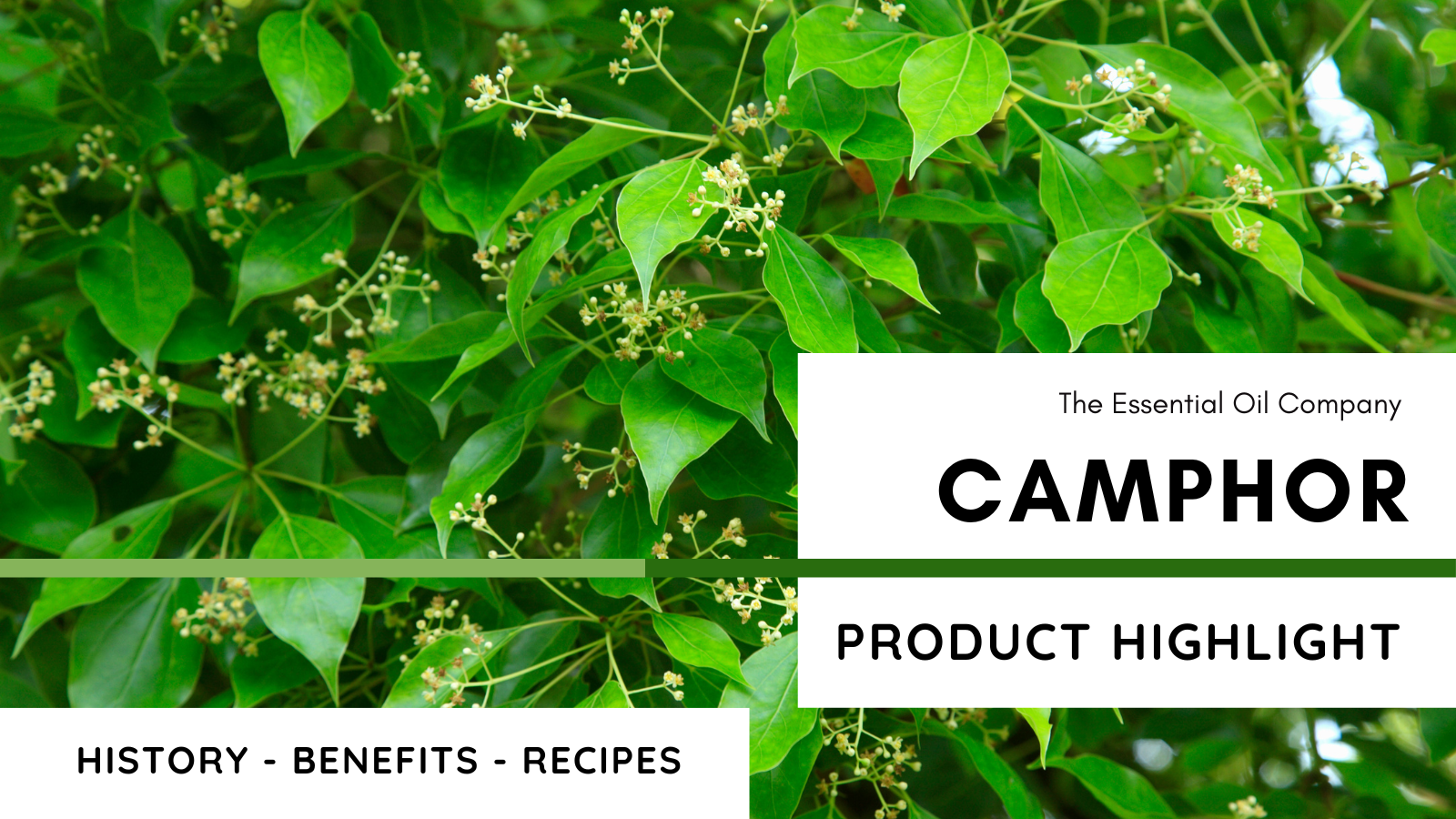
Camphor is native to areas of India, Taiwan, Southern China, Korea, Vietnam and Japan. The trees grow sixty to one hundred feet tall with stout cylindrical trunks. On younger trees the bark is bright green with a tinge of red. With age it turns gray-brown, rough and fissured. The leaves are bright green, ovate, smooth and glossy. They grow alternately along the twigs and give off a strong odor when crushed. In spring the trees carry clusters of small white to greenish-white flowers with six petals, which soon give way to berry-like fruits called drupes. The drupes are round and black and only about one centimeter across.
History
Camphor trees have long been cultivated for essential oil and timber. It is estimated that camphor was first extracted by distillation in the ninth century. In India and China the oil was used in religious ceremonies, and in China the wood was used to build temples and ships. In fourteenth-century Europe camphor was used in embalming.
From the late nineteenth century to the mid-twentieth century Taiwan produced and shipped large amounts of camphor in its solid form, before and during its Japanese colonization. At that time camphor went into smokeless gunpowder and into celluloid for film and toys. As demand grew, cultivation and essential oil production spread to Egypt, South Africa and Sri Lanka, where the climate also suited the tree.
Camphor trees were introduced to Florida in the late nineteenth century as ornamental shade trees, then spread across the Gulf Coast as they began to be grown for essential oil. Birds that ate the fruits carried the tree into natural areas, and it is now considered an invasive species in Florida.
How Camphor oil is made
The essential oil is extracted from the wood of the tree by steam distillation. After distillation the oil is vacuum rectified and filter pressed into four grades: white, yellow, brown and blue. White Camphor is the only grade used in aromatherapy.
Recipes with Camphor Essential Oil
Camphor, Bergamot and Frankincense Diffuser Blend
- 4 parts Camphor Essential Oil
- 3 parts Bergamot Essential Oil
- 3 parts Frankincense Essential Oil
Add water to your diffuser up to the fill line, then add the blend. The recipe is sized for a 200 mL ultrasonic diffuser, where it comes to about 0.5 mL of essential oil in total. Adjust the amount to the size and directions of your diffuser.
Camphor, Chamomile and Lavender Bath Melts
- 2 oz of Cocoa Butter Wafers
- 1 oz of Jojoba Oil
- 15 mL of Dried Lavender Buds
- 0.5 mL of Camphor Essential Oil
- 0.5 mL of Chamomile Essential Oil
- 0.5 mL of Lavender Essential Oil
- Small Silicone Molds
Heat the cocoa butter and jojoba oil in a double boiler until completely melted and combined. Remove from the heat and stir in the essential oils. Place a few lavender buds into each cavity of the silicone mold, then pour in the melted butter and oil mixture. Allow the melts to harden at room temperature for a few hours, or in the refrigerator for thirty minutes to one hour.
Find Camphor White Essential Oil in our essential oils collection.