

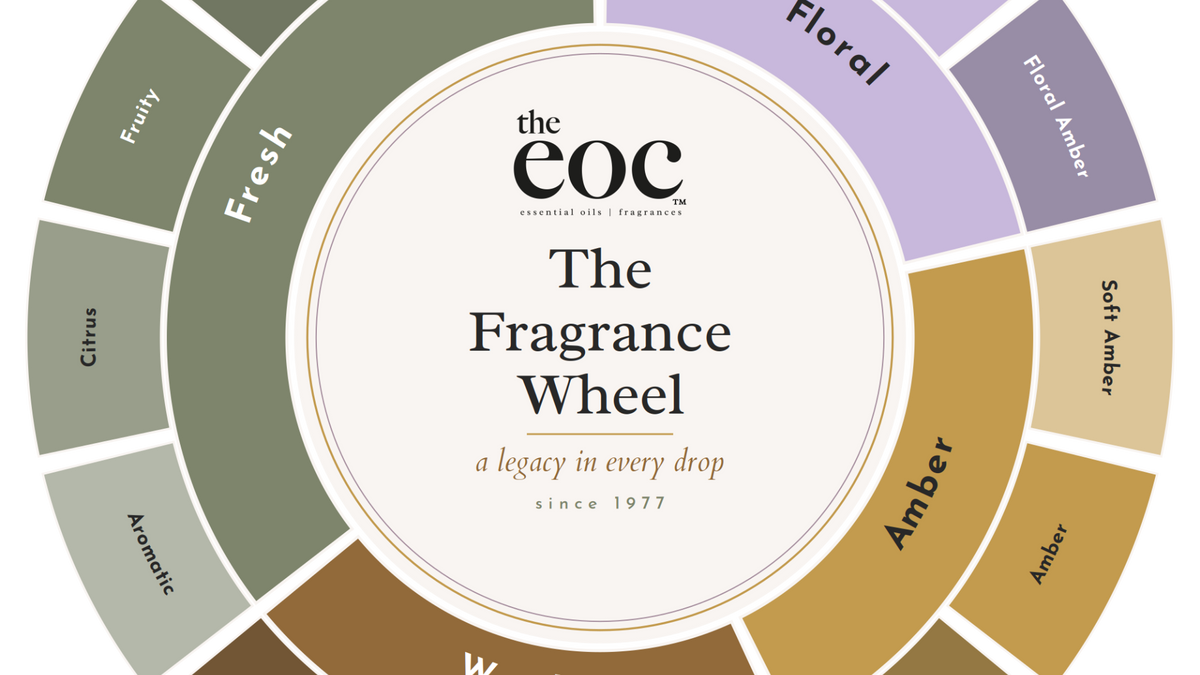
Blending gets easier when you can see how scents relate. This maker’s guide shows how to use the fragrance wheel and the note pyramid to build balanced blends, from the first bright top notes to a lasting base, with both essential oils and fragrance oils.
Download the PDF guide here or learn more here.
What is a fragrance wheel?
A fragrance wheel is a circular chart that organizes scents into families by character, then places related families side by side and opposite families across from each other. It gives you a fast way to predict how two materials will relate before you blend them. Read it as a map of character, not a measure of quality. A scent's position simply tells you how it tends to behave next to its neighbors.

What is the difference between a fragrance family and a fragrance note?
A fragrance family is the character of a scent, and a fragrance note is when that scent appears and how long it lasts. The wheel maps families, while the pyramid maps notes. You need both: families tell you what to combine, and notes tell you how the finished blend will unfold and how long it will hold.
What are the four fragrance families?
The four fragrance families are Fresh, Floral, Amber, and Woody. Fresh covers the bright, lifted, and clean scents: citrus, green, aromatic herbs, fruit, and cool watery notes, which open a blend and give it air. Floral covers the soft, romantic, and rounded scents, from a single crisp bloom to powdery florals. Amber covers the warm, resinous, and sweet scents: amber, balsams, vanilla, and warm spice. Woody covers the grounded, smooth, and lasting scents: cedar, sandalwood, patchouli, and drier woods. Around the rim, the facets run in order, so each family eases into the next: Fresh into Floral, Floral into Amber, Amber into Woody, and Woody back into Fresh.
What are top, heart, and base notes?
Top notes, heart notes, and base notes are the three layers of a fragrance, ordered by how quickly they evaporate. Top notes are the first impression: they are the lightest materials and lift within the first several minutes, and citrus oils and light herbs live here. Heart notes are the character of the blend: they come forward as the top notes fade and hold for a few hours, and florals, warm spices, and many herbs sit in the heart. Base notes are the lasting foundation: they are the heaviest materials, they appear during the dry-down, and they last the longest. Woods, resins, and vanilla live here, and they also slow the lighter notes above them so the whole blend lasts. Timings are approximate and shift with formula, skin, and setting.

How do kindred and complementary families work?
Kindred families sit next to each other on the wheel and blend in harmony, while complementary families sit across from each other and create contrast. Because kindred neighbors share character, they fold together smoothly and feel familiar, like Amber moving into Woody. Complementary families differ in character, which makes a blend feel complex and worth a second look, like a bright Fresh lift over a warm Amber base. Reach for kindred pairings when you want something easy and cohesive, and complementary pairings when you want something layered.

Kindred: adjacent families blend in harmony.

Complementary: opposite families create contrast.
Can you use the fragrance wheel by season?
Yes. As a merchandising lens, each family leans toward a season: Fresh into summer, Floral into spring, Amber into fall, and Woody into winter. It is a guide rather than a rule, and it gives a calendar a natural through-line for launches and campaigns across the year.

A seasonal lens on the same wheel.
Where do familiar scent categories like gourmand and marine fit?
Categories like gourmand, spicy, marine, ozonic, fruity, and green all sit inside the four families. Gourmand and spicy notes fall within Amber. Marine and ozonic, fruity, green, citrus, and aromatic notes fall within Fresh. Floral sits within Floral, and woods sit within Woody. Nothing is lost, it is simply grouped by character, which makes it easier to plan a full range.
Which oils sit in each fragrance family?
Every family maps to real oils, and the fullest blends often pair essential oils with fragrance oils.
- In the Fresh family, Bergamot, Lemon, Sweet Orange, Lime, Pink Grapefruit, and Lemongrass bring the citrus lift, with Clary Sage and Peppermint for the green and cool facets, along with fragrance oils Cool Citrus Basil, Cucumber Melon, Fresh Green Apple, and Wildflower and Fern.
- In the Floral family, Geranium, Rose, Ylang Ylang, Neroli, and Roman Chamomile anchor the character, with Jasmine Absolute for depth, along with fragrance oils Rose, Lilac, Evening Jasmine, and Japanese Cherry Blossom.
- In the Amber family, Ginger, Clove Bud, Cinnamon Leaf, and Black Pepper carry the warm spice, while Frankincense and Myrrh bring the resins, along with fragrance oils Dark Amber, Amber Glow, Vanilla, Frankincense and Myrrh, Sandalwood Vanilla, and Honey Bourbon.
- In the Woody family, Virginia Cedarwood, Atlas Cedarwood, Australian Sandalwood, Patchouli, and Vetiver form the base, along with fragrance oils Teakwood Mahogany, Rustic Woods, Sandalwood, and Sandalwood and Amber.
Frequently asked questions
How do you blend essential oils and fragrance oils together?
- Use the wheel to choose families that agree or contrast, then build by note. Lay down a base, add heart notes for character, and finish with a bright top. Blend in small test batches, let them rest, and adjust a drop at a time. Essential oils and fragrance oils combine well, and using both often gives a fuller, more consistent result.
What is a good starting ratio of top, heart, and base notes?
- A common starting point is roughly 30 percent top, 50 percent heart, and 20 percent base, then adjust to taste. Heavier bases last longer and slow the lighter notes above them, so a little goes a long way. Treat the ratio as a guide, not a rule, and let the materials and the finished format lead.
How many scents should you blend at once?
- Start with two or three. A small blend is easier to balance and to reproduce, and it teaches you how each material behaves. Once a simple blend works, add one material at a time so you can tell what each change does.
Why does a blend smell different after a few hours?
- Because notes evaporate at different speeds. The bright top notes lift off first, the heart carries the middle hours, and the heavier base is what lingers. That shift is the dry-down, and it is normal. Judge a blend by how it settles, not only by the first impression.
How do you test a fragrance blend before scaling up?
- Mix a small sample, smell it on a paper blotter, and let it rest so the notes can settle. Come back after a few hours and again the next day to judge the dry-down. When the small batch smells right in your actual format, scale up in the same proportions.
What is the difference between the fragrance wheel and the fragrance pyramid?
- The wheel sorts scents by character into families, so it tells you what to combine. The pyramid sorts scents by how quickly they evaporate into top, heart, and base notes, so it tells you how a blend will unfold and last. Use the wheel to choose, and the pyramid to structure.
Download the PDF guide here or learn more here.