
Frankincense essential oil is hydrodistilled from the hardened resin of Boswellia trees. The oil is thin, clear to pale yellow, with a sweet and earthy aroma.
Plant details
There are four basic types of Frankincense: Boswellia carterii and Boswellia frereana, which come from Somalia, Boswellia serrata, from India, and Boswellia sacra, from Oman. The Frankincense tree (Boswellia carterii) is a small deciduous tree in the Burseraceae family, typically six to thirty feet tall. It can have one trunk or several, covered in a papery bark that peels away easily.
The leaves are compound, with an odd number of leaflets growing opposite each other along the branches. New leaves are covered in a fine down. The tiny yellowish-white flowers gather in clusters, each with five petals surrounding ten stamens and a cup with five teeth. The fruit is small and capsule-like. Frankincense is derived from the tree's resin, a milky white sap. The trees begin producing it when they are around eight to ten years old.
History
The name "Frankincense" comes from the French term "franc encens," which means "pure incense." Oman is the earliest known source of Frankincense (traditionally Boswellia sacra) and exported the resin across India, China and the Mediterranean for thousands of years. Egyptians used Frankincense and natron during the mummification process.
The Greek historian Herodotus mentions Frankincense in "The History." He writes that the resin is dangerous to harvest because of winged snakes that guard the trees, and recommends burning storax so the smoke drives the snakes away.
Frankincense is mentioned as a prominent offering in ancient Hebrew sacrificial legislation. In the Book of Exodus, Frankincense blended with other spices is ground and burnt before the Ark of the Covenant as a holy offering. In the New Testament it is one of the three gifts, along with gold and myrrh, presented to the baby Jesus. Frankish Crusaders brought Frankincense to western Europe after journeys to the Eastern Roman Empire, where it was commonly used in church services. In medieval times it was often burned in religious spaces and during rituals.

Harvest and extraction
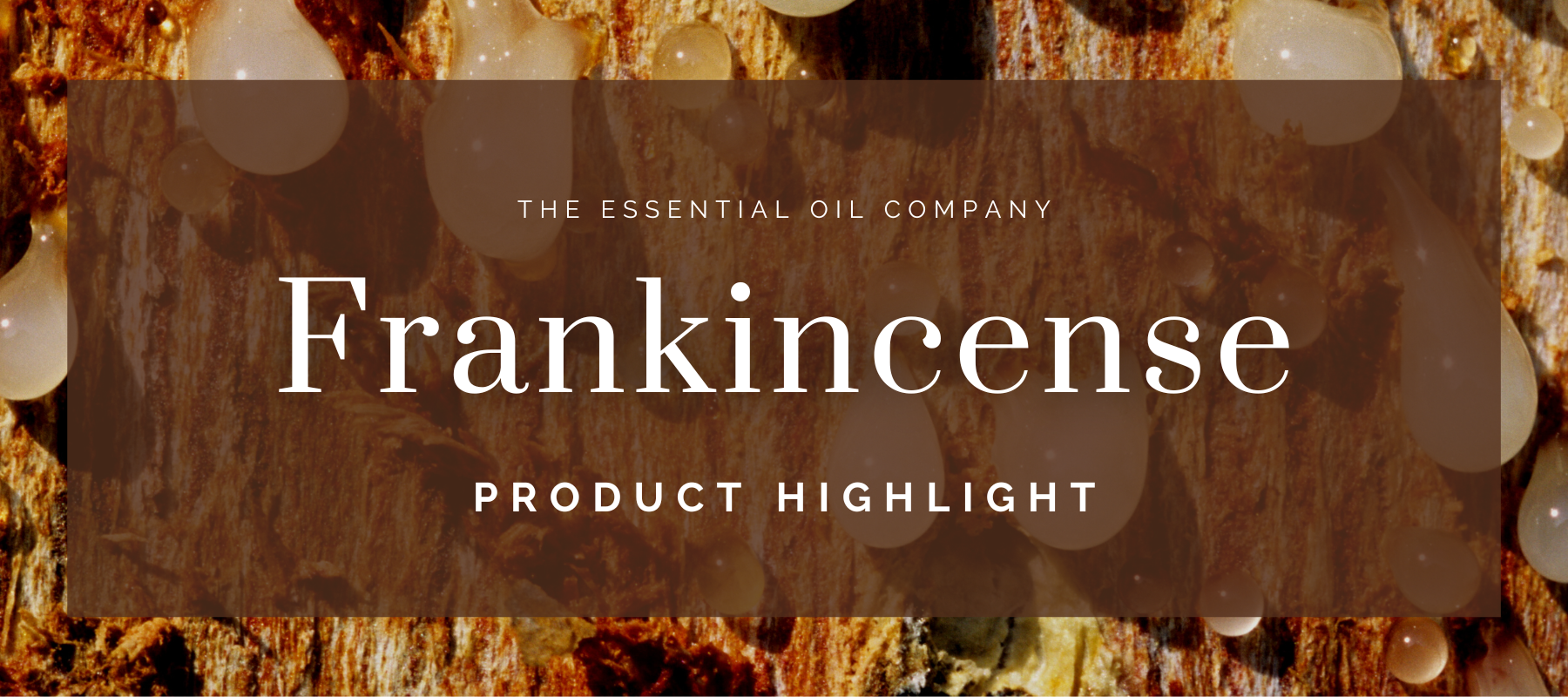
To harvest the resin, farmers make incisions in the bark until small tears of fluid begin to form. To get the best resin without damaging the tree, each tree is usually cut around three times. The droplets are left to dry and harden on the tree for three to ten days, then scraped off and left to dry until they harden completely. When dry they look like small, rough, translucent stones.
The quality of the resin is judged by the size and color of the hardened droplets, with larger size and lighter color being best. Most readily available resin is golden to amber, but very expensive, high-quality resin can be clear to white.
After drying, the resin is taken to the distillery and crushed into a powder. The essential oil is extracted by hydrodistillation. It is thin and clear to pale yellow, with a sweet and earthy aroma.
How makers use frankincense
Frankincense is used to scent room sprays, bath salts and household cleaners, and it has a long history as incense. In the recipes below it is blended with bergamot and patchouli, with lavender, patchouli and chamomile, and with cedarwood, eucalyptus and lemon.
Recipes
Frankincense, Bergamot and Patchouli Diffuser Blend
Ingredients
- 4 parts Frankincense Essential Oil
- 3 parts Bergamot Essential Oil
- 2 parts Patchouli Essential Oil
Instructions
Add water to your diffuser up to the fill line, then add the blend. The recipe was written for a 200 mL ultrasonic diffuser, using about 0.45 mL of oil in total. Adjust the amount to the size and directions of your diffuser.
Frankincense and Lavender Bath Salts
Ingredients
- 1 cup Epsom Salt
- 1/4 cup Dead Sea Salt
- 1/4 cup Baking Soda
- 15 mL Fractionated Coconut Oil
- 1 mL Frankincense Essential Oil
- 0.75 mL Lavender Essential Oil
- 0.5 mL Patchouli Essential Oil
- 0.25 mL Chamomile Essential Oil
Instructions
Pour the Epsom salt into a clean mixing bowl. Add the Dead Sea salt and baking soda and mix well. Add the fractionated coconut oil and essential oils and mix thoroughly. Store the mixture in an airtight glass container. To use, scoop about 1/4 to 1/2 cup of the salts into a warm bath. Let it dissolve completely before entering the water, to avoid slipping.

"Breath of Fresh Air" Room Spray
Ingredients
- 4 oz Amber Glass Bottle with spray top
- 2 oz Distilled Water
- 2 oz White Vinegar
- 1.5 mL Frankincense Essential Oil
- 1 mL Cedarwood Essential Oil
- 1 mL Eucalyptus Essential Oil
- 0.5 mL Lemon Essential Oil
Instructions
Add the vinegar and essential oils to the bottle. Fill the rest of the bottle with distilled water, leaving room at the top to mix. Shake well to combine thoroughly and again before each use. Spray around your home to deodorize as needed.
Find the oil used in these recipes here: Frankincense essential oil, also available as Certified Organic Frankincense (B. carteri).