
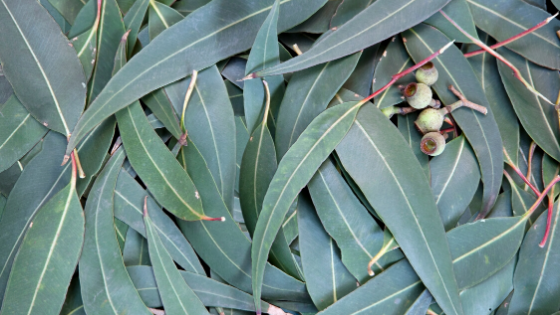
Eucalyptus citriodora (E. citriodora) oil is distilled from the leaves and branches of the tree. Eucalyptus citriodora trees are cultivated on plantations. These photos follow one plantation in Brazil from the test plots to the still, and on to what happens with the wood.
Selecting and growing the trees
Test plots have been established on this Eucalyptus citriodora plantation in Brazil to determine which trees exhibit the fastest growth, the highest essential oil yield and the most favorable chemical composition.
Promising individuals are identified and cloned to be planted in the field.
The trees are grown until they are approximately 6" DBH (diameter breast height), and then harvested for the branches and wood.
Harvesting the branches
Branches are cut from the trees and loaded on trucks, destined for the distillery.
Eucalyptus branches are loaded onto trucks.
The trucks are stacked high.
Sharp machetes are used to cut the branches from the trees.
At the distillery
The leaves and branches are brought to the distillery and loaded into the stills for making the Eucalyptus citriodora essential oil.
Eucalyptus citriodora branches are piled at the distillery.
A man inside the retort of the still makes certain the branches and leaves are packed tightly.
This old boiler is a workhorse, producing the large amount of steam required for distillation.
Spent Eucalyptus branches when the still is opened after distillation.
The essencier receives the distillate water from the condenser. There it is separated to become essential oil and hydrosol.
What about the lumber left over?
The logs that are cut from the trees are cut to size and brought to the area where they are turned into charcoal. The charcoal is then sold on the market for home cooking use.
Eucalyptus logs are stacked, waiting to be loaded onto trucks.
Special ovens have been built of clay brick for making charcoal.
The charcoal ovens are packed tightly.
A sealed charcoal oven. The flames on the inside have just started to burn, for the slow process of making charcoal from Eucalyptus citriodora wood.
The finished product, headed for the shelf in the local market. The Eucalyptus citriodora charcoal is used in homes for cooking.